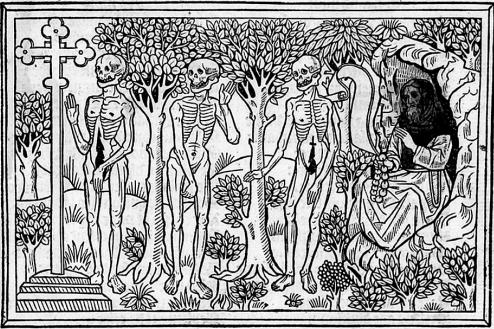
𝔄𝔡𝔞𝔪 𝔭𝔢𝔯𝔩𝔢: ℜ𝔢𝔠𝔬𝔶 𝔪𝔢𝔰 𝔣𝔦𝔩𝔷, 𝔭𝔯𝔢𝔫𝔰 𝔩𝔢𝔰 𝔢𝔫 𝔱𝔞 𝔪𝔢𝔪𝔬𝔦𝔯𝔢, 𝔔𝔲𝔬𝔶 𝔮𝔲𝔢 𝔧𝔢 𝔰𝔬𝔶𝔢 𝔳𝔦𝔩 𝔭𝔯𝔢𝔳𝔞𝔯𝔦𝔠𝔞𝔱𝔢𝔲𝔯, 𝔓𝔬𝔲𝔯 𝔞𝔲𝔤𝔪𝔢𝔫𝔱𝔢𝔯 𝔩'𝔲𝔰𝔲𝔣𝔣𝔯𝔲𝔦𝔠𝔱 𝔱𝔢𝔯𝔯𝔦𝔱𝔬𝔦𝔯𝔢 𝔇𝔬𝔫𝔠 𝔱𝔲 𝔢𝔰 𝔰𝔢𝔲𝔩 𝔭𝔯𝔦𝔫𝔠𝔦𝔭𝔢 𝔢𝔱 𝔡𝔦𝔯𝔢𝔠𝔱𝔢𝔲𝔯
Navigation
UFO in 15th Century Catholic Literature?
I did not expect for the inaugural blog post for this site to be anything like this, but here we are. The Holy Spirit moves as it
wills. Now that I am absolved of the venial sin of discussing aliens online, we can enter together into the mystery. Something surprised me as I perused an
archived copy of Compost et Kalendrier des Bergers from the late fifteenth century. The title is in Middle French, but a
straightforward translation would be The Shepherd's Almanac. True to its name, the Kalendrier has much of what you would expect from an
almanac as well as useful information for a French peasant in the late Medieval era. It contained calendars which appear to follow the
Roman Fasti style, combined with religious elements (such as daily memorials of saints) and information useful to people who work the
land (such as moon cycles). The days of the week and months of the year are represented allegorically in a beautiful synthesis of the
Medieval scholastic style and the flowery style of the budding French Renaissance. This alone is fascinating, because on one hand you have the
Medieval scholastics who preserved and developed Classical philosophy, and on the other you have a rediscovery of the ancient sources in
a new light. There truly is nothing new under the Sun.
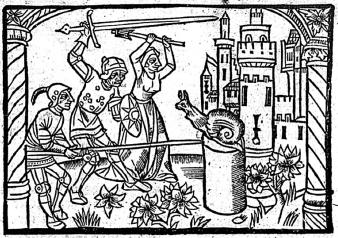
As an aside, look at this very funny poem about a woman going to war with a snail in her garden:
The Hardy Woman:
The Men at Arms:
The Snail:
A substantial portion of the almanac is devoted to catechesis. This is where I must admit to you, dear reader, that the title of this article contains an element of clickbait. And it is not the UFO
part! You see, I identified The Shepherd's Almanac as a work of Catholic Literature. That claim is quite true, in a sense. After all, I would never lie to you. Of the almanac's 70 pages, at least half of them are
dedicated to strictly religious material. The vast majority of pages feature at least a little reminder to maintain a particular virtue or a poem denouncing the folly of sin. In modern times, the Compost et
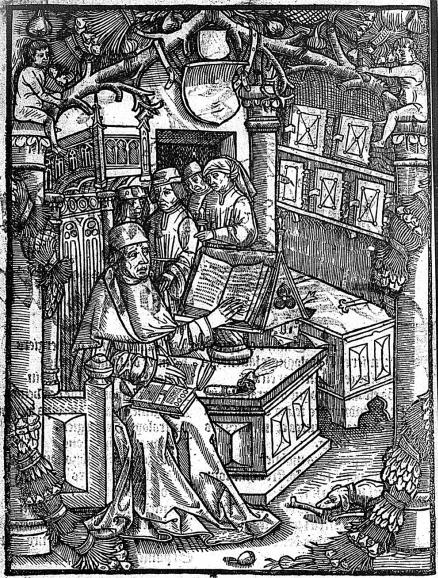
Kalendrier is most famous (I use that word quite loosely) for its vivid depictions of Hell according to the Revelation of Lazarus. This almanac was likely composed by a Catholic cleric, and the first page of the book
(see top) features a rather humorous etching of a Bishop looking perplexedly at his plebeian flocked with a mix of pity and disdain. Shout out to the dog gnawing on the scraps in the bottom corner. Why would I not
necessarily call this a work of Catholic Literature? Because the culture and social milieu in which this book was written is fundamentally inseparable from Catholicism. It would be like calling any book that is
produced today a work of Capitalist literature. Even this blog would not exist in its current form if it were not made in this current Capitalist paradigm. You cannot pull threads from the loom. You can only hope to
weave a more perfect image with the ones that are in play. But you already know all that. However, there is one more component of the almanac that I find quite intriguing. That is the scientific section, which
primarily attempts to teach illiterate shepherds the basics of contemporary astrology, astronomy, and anatomy. The tone of most of the almanac is that of condescension to the poor ignorant shepherds, which is
portrayed quite well in the aforementioned illustration of the author. I find it quite funny to imagine some humble illiterate peasant flipping through his almanac until his gaze sets on an annotated depiction of man
as a microcosm of the macrocosmos a la Bernardus Silvestris. Galaxy brain. It definitely makes one look at the destruction of human bodies in Lazarus' Hell in a new light. Of interest to you today, dear reader,
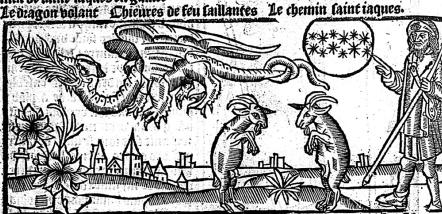
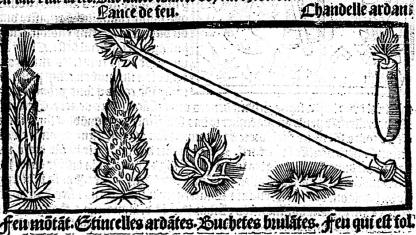
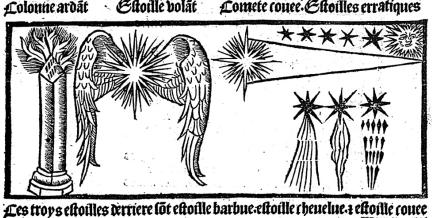
is the depiction of various astronomical phenomena which I will translate for you below directly from the original Middle French. I will then provide the original woodcut illustrations of said phenomena.
Shepherds who pass the night in the fields see many phenomena in the sky and on Earth which those who sleep in a bed never see. There have been sightings of a comet which flies through the air like a dragon breathing
fire from its throat. Others have reported fire frolicking through the air in the manner of leaping goats. This phenomenon does not last very long. Some have seen a white streak in the sky which can be seen at all
hours of the night as well as in the early morning. They call this the Great Way of Saint James in Gallicia. Other phenomena resemble rising flames. Others resemble flames which move from side to side. A third
kind of flame does not move and burns for a very long time. There are similar phenomena on Earth rather in the sky, and these resemble great torches and do not last very long. Others are like candles, sometimes fat
and sometimes skinny. These are seen in the air and on Earth. Another kind of comet is seen plummeting from Heaven like an ardent lance. Shepherds see yet other comets which take different forms such as an ardent
pillar which burns for a long time. Another form is that of a flying star which passes in the blink of an eye. The third form is that of a tailed comet which lasts longer than any other. They also see five erratic
stars which do not move like the others whatsoever. These are called planets, but they look like stars. They are: Saturn, Jupiter, Mars, Venus, and Mercury. Shepherds also see three stars which they call the bearded
star, the long-haired star, and the tailed star. There are also some phenomena in the illustrations which do not match the descriptions given in the text.
To be honest, I am quite skeptical of any claims of extraterrestrial visits to our planet. I do believe that there are unexplained phenomena, and I do think that a good number of those could be of a more exotic
provenance. However, I adhere to the classical Christian view that such things are angelic beings (in good standing or otherwise) or members of an order of creation that is unknown to me. At least I know that those
things exist. Obviously the modern popular conception of alien beings could fit quite neatly into any of those categories, especially the third. To each their own. I am quite ignorant, all things considered. Anyway,
let's look at some of the reported phenomena and debunk them in our holy inquisition of modernity:
Flying Dragon: This sounds a lot like a Halley's Comet or something similar. It is quite a stretch to call that a dragon, but I do think that the author is operating under a bit of artistic license here.
Leaping Goats: No clue. Your guess is as good as mine. I'd leave it as a UFO at least by the broadest definition. I could be truly spiteful towards our poor French forebearers and claim that what they saw were merely
fireflies. Do fireflies live in France?
Way of Saint James: This one is actually settled. Referring to the Milky Way in this fashion had been commonplace for hundreds of years by the time the Kalendrier was published. The discovery of Saint James' remains
in Gallicia warrants a UFO investigation in and of itself. Within the scope of this article, the Milky Way points towards the Southwest (towards Western Spain for most Europeans) and the milky glow of the stars is
said to be the dust kicked up by the countless pilgrims who have walked El Camino.
The second set of phenomena seems a bit more mysterious to me:
Rising Flame: No clue.
Sideways Flame: Maybe a shooting star? The original Middle French does not necessarily denote that the flame went to one side and then turned around and went the other way like my translation may lead you to believe.
Steadfast Flame: No clue. Make yourself right with God if you see this one.
Earthbound Torches: See above.
Phantom Candles: See above.
Ardent Lance: I would actually call this a meteorite without reservation. The description is remeniscent of Luke 10:18.
Ardent Pillar: See Steadfast Flame.
Flying Star: I think that this is obviously a shooting star and the illustration for it goes way too hard.
Tailed Comet: This must be Halley's Comet. Flying Dragon is vindicated.
Planets: Not sure what to think of this one. Seems a bit pagan.
Special Stars: I could probably figure out what these are if I did a bit more research. My best bet is just that they are stars that were somewhat distinctive to the Medieval shepherd or astronomer.
There is also a very accurate account of the Ensisheim Meteorite, which landed just a few years before the publication of our beloved almanac.
There you have it. I hope that you enjoyed reading this article, and hopefully you found something of interest somewhere in there. God willing, this will be the most impious of my articles on this site. You should
check back sometime, though, even if you just came for the aliens. You may be surprised. Please pray for me. I guarantee that I pray for you everyday.
Flee from this place most odious beast
Who devours the villagers' vines
Sparing neither tree nor shrub
You strip them all down to their branches
I swear by my broomstick, move one inch closer if you want
And I'll give you such a whack
That they'll hear it all the way in Nantes
Snail, despite your great horns
The kingdom will not allow itself to be pillaged
And will make you flee
From this beautiful land where you reside
You will not eat a single leek
With that disgusting sauce that you make
We shall put you in a giant plate
With black pepper and onions
Retract your horns if you like
So that you may let us in
Otherwise we will force our way in
With our sharp and pointy swords
I am an abomination
I am but a snail
I carry my home on my back
I have neither flesh nor bones
I have two horns on my head
I resemble, in that way, a cow
I am armed with my home
I also have two pointy horns
If these knights approach me
They will feel them on their noggins
But I believe in good faith
That in fear of me they tremble